Agentic AI · RFP & RFI · ISO 27001 · SOC 2 Type 2

Agent Workflowrfp_rfi_agent

Win More RFPs and RFIs. Respond in Hours, Not Weeks.

Six subagents. Zero copy-paste. Audit-ready on every submission. Sensitive bids stay on-premise.

The rfp_rfi_agent agentic workflow synthesizes your knowledge base, routes NDA-restricted bids through an air-gapped inference path, detects compliance gaps before they become disqualifiers, and delivers fully sourced proposal drafts with mandatory HITL approval at every high-risk section.

Faster RFP & RFI turnaround
80%Of bid content auto-drafted
More concurrent bids, same team

The Problem

Manual RFP and RFI processes bleed revenue at every stage.

Revenue

RFPs and RFIs Are a Hidden Revenue Drain

  • Each bid costs $50,000–$150,000 in SME time before a single word is written.
  • Faster competitors submit while your team is still assembling the response group.
  • Missed RFI windows close the door before the formal RFP is ever issued.
  • Parallel bids collapse under coordination overhead; each one competes for the same SMEs.
  • Every missed deadline or thin response is direct revenue handed to a competitor.

Knowledge

Institutional Knowledge Dies Between Bids

  • Winning responses from past bids sit in individual inboxes with no index or retrieval path.
  • Every new RFP or RFI re-inventories the same capabilities, certifications, and case studies from scratch.
  • Response quality varies by author and deadline pressure; no standardized answer library exists.
  • When key proposal writers leave, institutional memory leaves with them.
  • RFI capability statements are rebuilt manually for every opportunity, regardless of prior work.

Risk

Compliance Gaps and Data Risk Sink Bids

  • Mandatory certification and security attestation requirements buried in 300-page documents go unread.
  • Missing a single compliance field triggers disqualification regardless of technical strength.
  • NDA-restricted RFP content processed through cloud tools violates data handling agreements.
  • Legal and security review bottlenecks surface at the final stage, after the damage is done.
  • No systematic coverage check means gaps are discovered post-submission, not before.

Specialized Subagents. One Winning Proposal.

Built by the lowtouch.ai team. Each subagent owns one stage of the RFP and RFI response workflow. Two HITL gates ensure every sensitive routing decision and every high-risk section carries a named human approval.

1

Knowledge Ingestion Agent

Indexes your knowledge base, past proposals, product specs, policy documents, and certification records from SharePoint, Confluence, and connected repositories. Builds a structured retrieval layer ready for instant citation.

2

Document Intake & Routing Agent

HITL

Parses the incoming RFP or RFI document and scans for NDA markers, ITAR, GDPR, and HIPAA flags. Routes sensitive bids to an air-gapped on-premise inference path. A HITL gate confirms routing before drafting begins.

3

Gap Detection Agent

Cross-references every requirement and evaluation criterion against the knowledge base; flags unanswered sections, missing certifications, and high-risk compliance gaps before any draft is generated.

4

Draft Generation Agent

Auto-populates responses using matched knowledge base content, maintaining consistent tone and sourcing every answer to its origin document. RFI capability matrices and RFP technical sections are both handled in this stage.

5

HITL Review Agent

HITL

Routes flagged sections to assigned SME reviewers via commit reviews and pull request approvals. Nothing is included in the final submission without explicit sign-off from a named reviewer.

6

Submission Agent

Compiles the reviewed proposal into the required format (Word, PDF, or portal upload). Every response is versioned, timestamped, and linked to its source document for a full audit trail.

RFP and RFI Response Across Every Industry

Enterprise technology, GCCs, IT services, and public sector. Every bid format, every compliance framework, handled.

Enterprise Technology Bids

Enterprise
  • RFP and RFI documents parsed and structured in minutes; requirement matrix auto-generated.
  • Knowledge base synthesized from policy docs, past bids, product specs, and compliance certifications.
  • Gap detection flags unanswered sections and missing attestations before draft generation begins.
  • HITL gates route pricing, SLA, and security sections directly to named approver queues.
3 weeks to 3 days

GCC Capability Statements

GCC
  • Capability library indexed once across all GCC centers; reused across every RFP and RFI.
  • Headcount, certifications, delivery metrics, and case studies populated from the knowledge base automatically.
  • SOC 2 Type 2 and ISO 27001 attestations mapped to each evaluation criterion.
  • HQ approval workflow managed through HITL gates; sensitive bid content routed on-premise.
Zero SME bottleneck

IT Services Proposals

IT Services
  • Past engagement summaries, case studies, and client references indexed and cited automatically.
  • RFI capability matrices and RFP technical architecture sections drafted from reusable component libraries.
  • Pricing, SLA, and commercial terms sections routed to commercial approval queues via HITL.
  • Win/loss pattern tracking refines the knowledge base after every closed opportunity.
Institutional memory, live

Public Sector & Defense

Public Sector
  • Mandatory disclosure and security attestation sections identified and populated from the compliance library.
  • Evaluation criterion coverage verified before submission; zero missing or incomplete fields.
  • Data residency, clearance requirements, and ITAR/HIPAA flags routed through the air-gapped inference path.
  • Multi-level HITL approval for legal and compliance sections; every approval attributed and timestamped.
Compliance-first drafting

Enterprise-Grade Capabilities Built In

From air-gapped sensitive data routing to win rate analytics, the rfp_rfi_agent agentic workflow is built on the full depth of the lowtouch.ai platform.

Knowledge Base Synthesis

Answers sourced from policy docs, past proposals, and certifications. Every response is traceable; no hallucination.

Gap Detection

Flags unanswered sections and compliance gaps before drafting begins, when issues can still be fixed.

HITL Approval Gates

High-risk sections routed to named SME reviewers via pull request approvals. Nothing submits without explicit sign-off.

Audit Trail

Every version, reviewer, and source document timestamped and logged. Full traceability from requirement to submission.

Compliance Mapping

Maps evaluation criteria to your certifications (SOC 2 Type 2, ISO 27001, HIPAA) and flags gaps before they disqualify.

Agent Orchestration

Custom subagents built by the lowtouch.ai team coordinate ingestion, intake, drafting, review, and submission. No middleware.

Sensitive Data Workflow

Air-gapped inference for NDA, ITAR, and HIPAA bids. On-premise LLM replaces cloud calls; zero content leaves your infrastructure.

RFI Response Automation

Handles RFIs with the same pipeline as full RFPs. Populates capability matrices, headcount data, and certification registers automatically.

Win Rate Analytics

Tracks response quality and submission performance. Surfaces which templates win and informs knowledge base pruning after every bid.

Measurable Impact from the First RFP

Faster RFP & RFI turnaround vs manual process
80%Of bid content auto-drafted from knowledge base
0Missed compliance requirements post-submission
100%Audit trail on every submission

Free Your Best People from Proposal Grunt Work

SMEs spend 20–30% of their time on bid responses. The rfp_rfi_agent handles synthesis and drafting, routing only the decisions that require human judgment.

  • Free 8–12 hours of SME time per bid, per reviewer.
  • Redirect technical talent to billable delivery and innovation.
  • No SME queue for standard knowledge sections or certification lookups.

Run 3× More Bids with the Same Team

Parallel RFP and RFI pipelines run simultaneously. Each subagent operates independently across concurrent bids; your team only touches the decisions that matter.

  • 3× concurrent bid capacity without additional proposal staff.
  • Consistent quality across all submissions regardless of team bandwidth.
  • No throughput ceiling tied to individual reviewer availability.

Every Submission Makes the Next One Stronger

The knowledge base indexes reviewer edits and winning responses. Quality compounds with every closed bid; the system learns which answers win and which lose.

  • Best-performing answer templates reused automatically across future bids.
  • Zero missed evaluation criteria on submissions; coverage verified pre-draft.
  • Win/loss patterns feed knowledge base pruning after every closed opportunity.

Integrated with Your Existing Toolchain

No rip-and-replace. Works with the knowledge repositories, CRM, procurement portals, and private cloud infrastructure you already run.

SharePoint

Knowledge repository

Confluence

Documentation source

Salesforce

Opportunity tracking

SMTP / MS Teams

Reviewer notifications

SNOW / Jira

Review workflow

GPT-4o / Claude

Draft generation

Entra ID / Okta

Agent authentication

Contract Repository

Historical proposals

Document APIs

Multi-format output

Private Infra

Zero data egress

Google Drive / Box

Cloud file storage

HubSpot / Dynamics 365

CRM pipeline sync

Slack

Reviewer escalation

DocuSign / Adobe Sign

Submission e-signatures

Ariba / SAP MM

Procurement portal sync

Gemini / Llama (on-prem)

Air-gapped inference

Internal Vector Store

Knowledge retrieval

Word / Google Docs

Editable output formats

Notion

Lightweight knowledge base

AWS / Azure / GCP

Private cloud deployment

Frequently Asked Questions

Common questions about AI-powered RFP and RFI response automation.

How long does it take to respond to an RFP with AI automation?

+

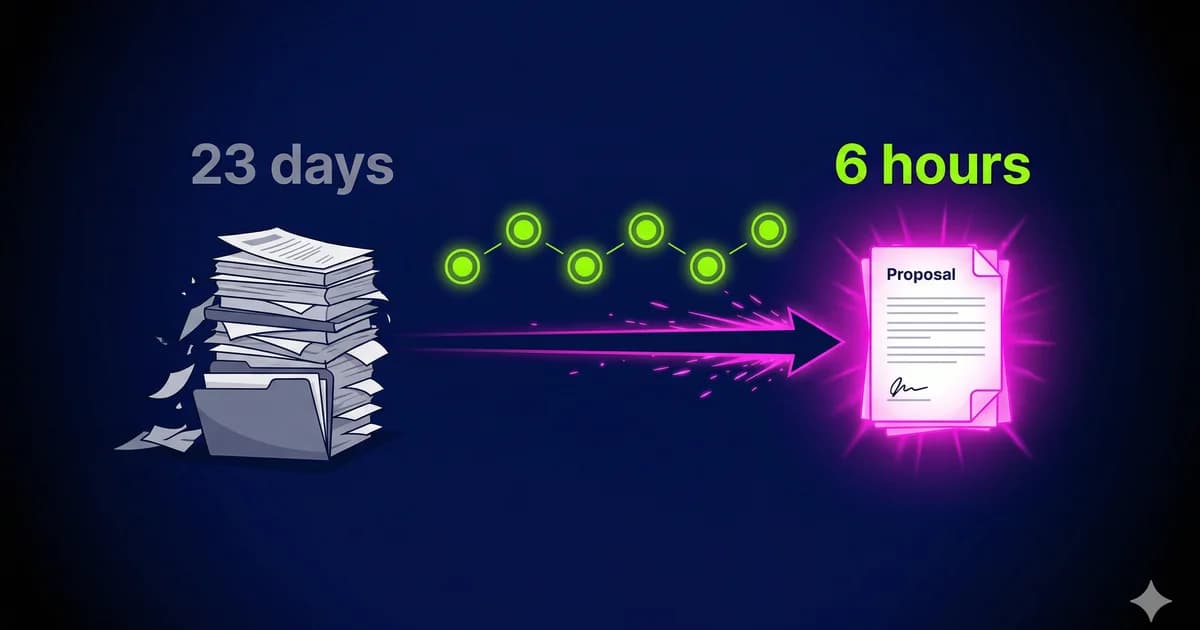
Manual RFP cycles average 23 working days from intake to submission. With the rfp_rfi_agent agentic workflow, the same process runs in under 6 hours: knowledge ingestion and gap detection run in parallel, 80% of responses are auto-drafted from your knowledge base, and remaining sections route to named reviewers via HITL approval gates. Teams typically complete first-pass review within a single business day.

How does AI automate RFP and RFI responses?

+

The rfp_rfi_agent uses specialized subagents: one indexes your knowledge base (past proposals, policy docs, certifications), another parses the incoming RFP or RFI document, a third flags compliance gaps before drafting begins, and a fourth generates responses sourced directly to origin documents. Two HITL gates ensure sensitive routing decisions and high-risk sections carry explicit human approval before submission.

Can the same AI agent handle RFI responses as well as RFPs?

+

Yes. The rfp_rfi_agent handles Requests for Information (RFIs) with the same pipeline as full RFPs. RFI capability matrices, headcount data, certification registers, and delivery metrics are populated automatically from your knowledge base. The same audit trail, compliance mapping, and HITL approval gates apply to both document types.

How do HITL approval gates work in RFP automation?

+

Human-in-the-loop controls work through commit reviews and pull request approvals. When the Document Intake agent detects sensitive data (NDA, ITAR, HIPAA flags), a HITL gate confirms the routing decision before any draft is generated. When the Draft Generation agent flags high-risk sections (pricing, security attestations, SLA commitments), those sections route to named SME reviewers. Nothing is included in the final submission without explicit, attributed sign-off.

Is sensitive RFP and RFI content safe when processed by AI?

+

For bids flagged as NDA-restricted, ITAR, HIPAA, or classified-adjacent, the rfp_rfi_agent routes the full workflow through an air-gapped on-premise inference path. Cloud LLM API calls are replaced with a locally-deployed model; zero content leaves client infrastructure. The platform is private-by-architecture: SOC 2 Type 2 and ISO 27001 certified, with support for fully air-gapped deployments.

What is the average RFP win rate, and can AI automation improve it?

+

Industry-wide, the average RFP win rate is 45% (Bidara, 2026). Teams that use AI-native tools report improvements from consistent use of best-performing answer templates, zero missed evaluation criteria, and higher-quality compliance coverage. The rfp_rfi_agent tracks win/loss patterns after every closed bid and feeds those learnings back into the knowledge base, compounding response quality over time.

From the Blog

Go Deeper on RFP and RFI Automation

How to Reduce RFP Response Time from Weeks to Hours with AI
How-To Guides

How to Reduce RFP Response Time from Weeks to Hours with AI

The average enterprise team spends 23 working days on a single RFP response. AI-native automation cuts that to under 6 hours with full auditability.
Loopio Alternative for Enterprises That Need HITL Controls and Private Deployment
AI Insights

Loopio Alternative for Enterprises That Need HITL Controls and Private Deployment

Loopio automates content retrieval, not response generation. Enterprises needing HITL gates and air-gapped deployment need a different platform.

RFP and Capability Statement Automation for GCCs and IT Services Firms
How-To Guides

RFP and Capability Statement Automation for GCCs and IT Services Firms

GCCs respond to more RFPs per year than almost any enterprise segment. Manual processes break under that volume. Here is what AI-native automation looks like.

See how enterprises deploy agents like this in production.

Read real-world customer results →

More Agents

Explore the Full Agent Catalog

Your agents, live.
ROI in the first quarter.

30%Cut in IT costs
80%Of repetitive tasks automated
<6 weeksTo deploy — zero data leaves your environment